

By MaryKate DeSantis (EdM, CAS), Jack Dempsey (PhD), and Julie Van Dyke (PhD)
Background
National efforts mandating evidence-based practices have centered on implementing reading instruction through explicit and systematic instruction. Also known as structured literacy, this approach treats phonological skills as foundational for mastering word recognition. However, as students progress through school, language demands increase, and decoding skills alone are not sufficient to produce skilled comprehenders. Despite the pedagogical gains in understanding how to foster skilled word reading, our classrooms continue to be filled with struggling readers, especially as they progress through upper elementary school.
One reason for this persistent challenge is the belief that intervening to improve decoding will lead naturally and automatically to improved reading comprehension. Structured literacy programs have produced dramatic gains in word reading ability, yet reading scores on our Nation’s Report Card remain largely flat. This is a stark indicator that even science-aligned instruction in word recognition is insufficient, especially for marginalized populations.
Today, we must confront the urgent question, “What are we missing?”
Comprehension arises from the ability to process each sentence individually and assemble it with others to create a cohesive whole. Syntactic knowledge is the “glue” that holds the words in a sentence together, allowing the reader to understand how the actions, entities, and ideas in the sentence relate to one another. However, this foundational knowledge is often overlooked when considering the path to understanding oral and written texts. Without direct instruction that targets syntactic processing, students are left to navigate the complexities of language without an understanding of how the structure of sentences conveys meaning.
Suppose a teacher listens to a fourth-grade student laboriously stumble through a grade-level text, showing a breakdown in prosodic expression and no apparent understanding of sentence structure. In this case, it is likely that this student did not comprehend what was read. The most common instructional move for this student is to improve word reading accuracy and rate; unfortunately, this approach overlooks the skills needed to comprehend: a focus on the sentence-level skill of syntax. From a Structured Literacy and Science of Language perspective, this is a lost opportunity! Over 40 years of psycholinguistic research has demonstrated that “syntactic structure, sentence composition, and word meanings form the core engine that supports language comprehension…” [1]
To advance beyond our current national reading scores, we must ensure that classroom instruction continues to focus on the Science of Reading – and also the Science of Language Processing.
We must always consider the language processes that simultaneously occur as the reader is lifting words off the page. Professional learning must include training about how the comprehension process unfolds, including details about the central contribution that syntactic knowledge makes in this process. Teachers require coaching to help them recognize when a student’s difficulty with comprehension stems from factors beyond decoding, such as challenges related to processing the language itself. Practically speaking, students benefit from repeated exposures to a variety of syntactic forms embedded within complex texts, and teachers benefit from tools that can support engagement with these texts. Furthermore, the most impactful tools are those that integrate into any curriculum seamlessly. This makes Cascade Reading a powerful tool for addressing the current gap in reading education, providing a scaffold for syntactic knowledge during reading.
The Study
Previous research has shown that reading in the Cascade Format improves comprehension, and this is true for 4th and 5th graders as well as for adults. Since Cascade Reading is specifically designed to provide visual cues to the syntactic structure of a sentence, it is natural to expect that syntactic knowledge may also be improved as a result of reading in the Cascade Format. However, thus far we have not measured syntactic knowledge in our research. For the current study, we teamed up with several 3rd, 4th, and 5th grade classrooms in a private elementary school in Delaware to gain insights about the relationship between reading in the Cascade Format and syntactic knowledge. We recognized the possibility that reading in Cascade would not improve syntax, since no explicit or direct instruction in syntax occurred. However, we also knew that the human capacity for implicit learning could be triggered via exposure to written language that has its syntactic components highlighted so that they are easier to recognize.
Through drawing attention to the syntactic relationships within a sentence, we hypothesized that reading in Cascade could lead to improvements in syntactic knowledge itself.
To test this, we conducted a semester-long study in which students read several passages per week from the Cascade Passage Library on either Chromebooks or tablets, matched in terms of complexity with their reading ability level. To assess possible gains in syntactic knowledge, we had students complete a syntactic knowledge assessment at the beginning of the semester and then again after 11 weeks of reading in the Cascade Format. This assessment presented students with a series of sentences that were either grammatically correct or ill-formed, and students needed to determine whether or not they were correct or “sounded weird.” Higher scores on the assessment indicate higher syntactic knowledge.
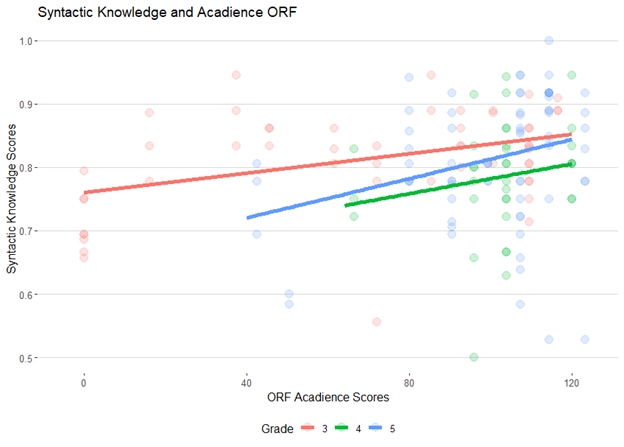
For the initial assessment, we were interested in how this measure of syntactic knowledge correlated with benchmarking scores from Acadience Reading assessments taken earlier that school year. We found a significant relationship between a student’s Acadience composite scores and their ORF scores. This shows that oral reading fluency, another skill important for measuring student reading ability, is also related to a student’s syntactic knowledge. This result is consistent with a large body of work relating reading fluency to prosodic expression and syntax. [2]
As the semester progressed, all students read passages in the Cascade Format. Although we give up some experimental rigor by not having a control group, our previous research made us confident that the Cascade Format would increase reading comprehension scores. Hence, we felt it better to give all students the opportunity to grow from using our tool. Over the course of 11 weeks of reading, students read a total of 25 passages and answered questions ensuring they were reading for comprehension. We also conducted regular motivational checks with incentives for all students to maximize their engagement levels throughout the semester.
When comparing scores on the syntactic knowledge assessment from the beginning of the semester to after 11 weeks of reading with the Cascade Format, we found a significant increase in syntactic knowledge.

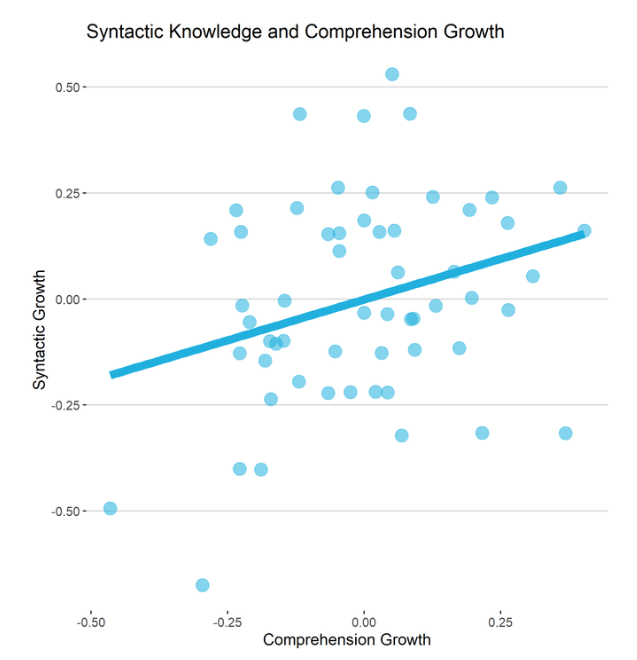
Furthermore, we wanted to test whether individual growth rate was related to success on comprehension scores on the daily reading activities. To do this, we used model-based estimates of individual syntactic knowledge growth rates from each student and tested for a correlation between those rates and their model-based individual comprehension growth curve.
This analysis revealed a significant relationship, meaning that there is a connection between growth in syntactic knowledge and growth in comprehension performance with repeated exposure to the Cascade Format.
The key takeaways from these data are as follows:
- Students experienced an increase in syntactic knowledge after repeated exposure to the Cascade Format.
- This syntactic knowledge metric is significantly related to Acadience oral reading fluency scores.
- Growth in syntactic knowledge is significantly related to growth in comprehension performance when reading with the Cascade Format.
Why These Results Matter
These results are important because they provide insights about how the experience of reading in the Cascade Format affects students’ brains. Cognitive psychology tells us that implicit learning is the primary mechanism through which humans learn language – or anything else for that matter! Simply put, we learn what we’re exposed to. But there is wide variability in how well students learn implicitly. [3, 4]
For some, explicit instruction is not necessary at all, while for others, especially those with language-based learning disabilities, explicit instruction is crucial. Nancy Young’s Ladder of Reading & Writing infographic provides a nice way to think about this continuum.
Those with implicit learning challenges have difficulty perceiving crucial acoustic and prosodic cues [5, 6, 7, 8, 9, 10], and these difficulties are also associated with low ability in a variety of literacy-related skills, including oral language ability, comprehension of complex syntactic structures, word reading, vocabulary ability, and phonological processing. [11, 12, 13, 14, 15] For these individuals, explicit literacy instruction, such as drawing attention to grapheme-phoneme correspondences, works because it structures the learning environment in a way that makes the relevant parts of language more obvious. Drawing attention to specific elements of text is like flashing a neon light over exactly what aspects of the environment the learner needs to attend to. This is why structured literacy works, although ironically, from a Science of Learning perspective, it is not the explicit instruction itself that makes a difference, but the effect it has on the implicit learning experience. [16]

Cascade Reading is unique in its ability to highlight the crucial relationships within a sentence without any explicit instruction. The findings in this study show that improvements in syntactic knowledge, and concurrent improvements in reading comprehension, arise simply from repeated exposure to the Cascade Format. This offers a meaningful solution to the tradeoff between devoting time to explicit instruction versus actual reading. Shockingly, research shows that beginning readers may spend barely two minutes a day on actual reading (Kent et al., 2012; Wanzek et al., 2014), which is surely not enough practice to effectively internalize and consolidate even the best explicit instruction.
Cascade Reading offers a solution by providing explicit cues to syntax during the actual reading practice.
This means that syntactic exposures can still be intentional, made so by the explicit visual cues provided by the format, without compromising on authentic texts or immersive learning experiences. Teachers don’t need to have detailed knowledge of syntax because the format provides the implicit, in-the-moment guidance so that learners can get on with the business of reading practice. Overall, this is a real win for teachers and learners alike!